How Playing Music affects The Developing Brain
Remember “Mozart Makes You Smarter”?
A 1993 study of college students showed them performing better on
spatial reasoning tests after listening to a Mozart sonata. That led to
claims that listening to Mozart temporarily increases IQs — and to a
raft of products purporting to provide all sorts of benefits to the
brain.
In 1998, Zell Miller, then the governor of Georgia, even proposed
providing every newborn in his state with a CD of classical music.
But subsequent research has cast doubt on the claims.
Ani Patel, an associate professor of psychology at Tufts University
and the author of “Music, Language, and the Brain,” says that while
listening to music can be relaxing and contemplative, the idea that
simply plugging in your iPod is going to make you more intelligent
doesn’t quite hold up to scientific scrutiny.
“On the other hand,” Patel says, “there’s now a growing body of work
that suggests that actually learning to play a musical instrument does
have impacts on other abilities.” These include speech perception, the
ability to understand emotions in the voice and the ability to handle
multiple tasks simultaneously.
Patel says this is a relatively new field of scientific study.
“The whole field of music neuroscience really began to take off
around 2000,” he says. “These studies where we take people, often
children, and give them training in music and then measure how their
cognition changes and how their brain changes both in terms of its
processing [and] its structure, are very few and still just emerging.”
Patel says that music neuroscience, which draws on cognitive science,
music education and neuroscience, can help answer basic questions about
the workings of the human brain.
“How do we process sequences with complex hierarchical structure and
make sense of them?” he asks. “How do we integrate sensation and action?
How do we remember long and difficult sequences of information?
These are fundamental neuroscience questions, and music can help us
answer some of these questions, because it’s in some ways simpler than
language, but it’s still of sufficient complexity that it can address
these very deep and important aspects of human brain function.”
In addition, Patel says music neuroscience research has important
implications about the role of music in the lives of young children.
“If we know how and why music changes the brain in ways that affect
other cognitive abilities,” he says, “this could have a real impact on
the value we put on it as an activity in the schools, not to mention all
the impact it has on emotional development, emotional maturity, social
skills, stick-to-itiveness, things we typically don’t measure in school
but which are hugely important in a child’s ultimate success.”
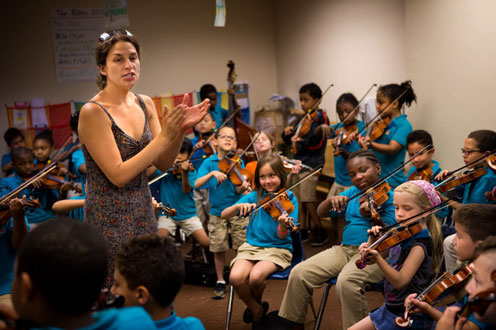
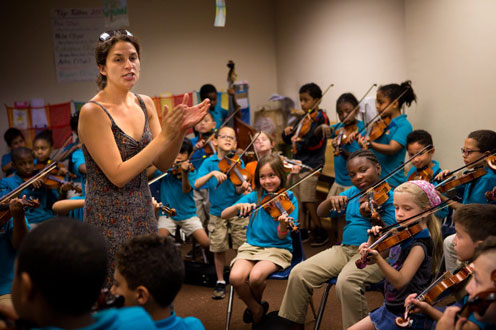
Kathleen
Jara, co-director of the El Sistema program at the Conservatory Lab
Charter School in Boston, directs orchestra students during a rehearsal
for their year-end recital. (Jesse Costa/WBUR)
At the Conservatory Lab Charter School in Boston, every student receives music instruction.
“It doesn’t matter whether they have had music instruction before or not,” says Diana Lam, the head of the school.
The school, which accepts new students by lottery, is bucking a
national trend, as more and more cash-strapped school districts pare
down or eliminate music programs.
Lam says music is part of her school’s core curriculum because it
teaches students to strive for quality in all areas of their lives — and
because it gets results.
“Music addresses some of the behaviors and skills that are necessary
for academic success,” she says. “Since we started implementing
El Sistema, the Venezuelan music program, as well as project-based learning, our test scores have increased dramatically.”
Musically Trained Kids With Better Executive Functioning Skills
But what does
the latest scientific research
tell us? The question, according to neuropsychologist Nadine Gaab, is
not simply whether music instruction has beneficial effects on young
brains.
“There’s a lot of evidence,” Gaab says, “that if you play a musical
instrument, especially if you start early in life, that you have better
reading skills, better math skills, et cetera. The question is, what is
the underlying mechanism?”
At her lab at Boston Children’s Hospital, Gaab leads a team of
researchers studying children’s brain development, recently identifying
signs in the brain that might indicate dyslexia before kids learn to
read, as we discussed in
an earlier report from this series. Gaab and her colleagues are also looking for connections between musical training and language development.
“Initially we thought that it’s training the auditory system, which
then helps you with language, reading and other academic skills,” she
says.
Instead, in a study published last month, Gaab and her team
delineated a connection — in both children and adults — between learning
to play an instrument and improved executive functioning, like
problem-solving, switching between tasks and focus.
“Could it be,” Gaab asks, “that musical training trains these
executive functioning skills, which then helps with academic skills?”
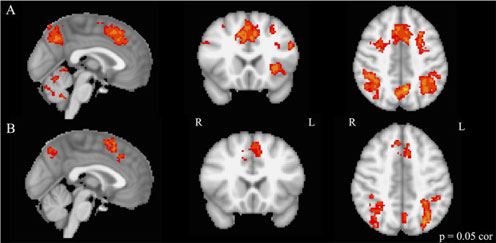
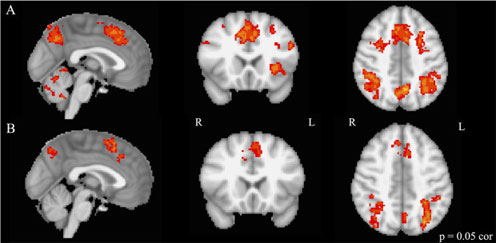
MRI
scans show brain activation during executive functioning testing. The
top row, row A, is of musically trained children. The bottom row, row B,
is of untrained children. There’s more activation in the musically
trained children. (Courtesy Nadine Gaab)
To find out, researchers gave complex executive functioning tasks to
both musically trained and untrained children while scanning their
brains in MRI machines.
“For example,” Gaab says, “you would hear the noise of a horse,
‘neigh,’ and every time you hear the horse, whenever you see a triangle
you have to press the left button and whenever you see a circle you have
to press the right button. However, if you hear a frog, the rule
switches.”
While noting the children’s ability to follow the rules, the
scientists also watched for activity in the prefrontal cortex of the
brain, known to be the seat of executive functioning.
“We were just looking at how much of the prefrontal cortex was
activated while they were doing this ‘neigh-froggy’ task in the
scanner,” Gaab says. “And we could show that musically trained children
and professional adult musicians have better executive functioning
skills compared to their peers who do not play a musical instrument. We
could further show that children who are musically trained have more
activation in these prefrontal areas compared to their peers.”
So does music-making enhance executive functioning?
Gaab hastens to add, “We don’t know what’s the egg and what’s the
hen.” That is, whether musical proficiency makes for better executive
functioning, or vice-versa.
But Gaab cites other studies which imply the former.
“It’s most likely the musical training that improves executive
functioning skills,” she says. “You could just hypothesize that playing
in an orchestral setting is particularly training the executive
functioning skills because you have to play in a group; you have to
listen to each other.”
And Gaab says that’s analogous to what happens in the brain of a musician.
“There are a lot of different brain systems involved in successfully
playing even a small musical piece: your auditory system, your motor
system, your emotional system, your executive function system; this
playing together of these brain regions, almost like in a musical
ensemble.”
Changing ‘Brain Plasticity’
But the question remains: Why would acquiring musical skills
influence language and other higher brain functions? Neuropsychologist
Patel has developed a theory he calls the OPERA hypothesis.
“The basic idea is that music is not an island in the brain cut off
from other things, that there’s overlap, that’s the ‘O’ of OPERA,
between the networks that process music and the networks that are
involved in other day-to-day cognitive functions such as language,
memory, attention and so forth,” he says. “The ‘P’ in OPERA is
precision. Think about how sensitive we are to the tuning of an
instrument, whether the pitch is in key or not, and it can be painful if
it’s just slightly out of tune.”
That level of precision in processing music, Patel says, is much
higher than the level of precision used in processing speech. This
means, he says, that developing our brains’ musical networks may very
well enhance our ability to process speech.
“And the last three components of OPERA, the ‘E-R-A,’ are emotion,
repetition and attention,” he says. “These are factors that are known to
promote what’s called brain plasticity, the changing of the brain’s
structure as a function of experience.”
Patel explains that brain plasticity results from experiences which
engage the brain through emotion, are repetitive, and which require full
attention. Experiences such as playing music.
“So this idea,” he says, “that music sometimes places higher demands
on the brain, on some of the same shared networks that we use for other
abilities, allows the music to actually enhance those networks, and
those abilities benefit.”
One striking example of this is the use of singing to restore speech. At the
Music and Neuroimaging Lab
at Beth Israel Deaconess Medical Center, Dr. Gottfried Schlaug has
pioneered singing as a therapeutic method of rehabilitating victims of
stroke and other brain injuries, as well as people with severe autism.
And some of the most recent music neuroscience research is using
music as a tool to better understand, and even predict, language-based
learning disabilities.
But not all of the ideas behind this research, or even the methods, have come from scientists.
Using Music To Test Literacy Ability
Paulo Andrade teaches music at Colegio Criativa, a private school in
Marilia, Brazil. He and his wife Olga, who’s also a teacher there,
became interested in the relationship between musical and language
skills among their elementary school students.
“We both work with the same children,” Andrade says, “and we started
to exchange information about how the children were going. I could
relate the musical development of children to their language ability and
literacy.”
Andrade developed some collective classroom tasks to identify
children at risk of learning disabilities. He asked his second-grade
music class to listen to him play a series of chord sequences on the
guitar, and identify each one.
“I asked [the] children to write visual symbols to represent the
sound sequence they were hearing,” he explains, “a simple line to
express chords in the high register and a circle to represent the chords
played in the low register.”
Andrade made the students pause before writing down the identifying
symbol. This would test their working memory, a kind of mental Post-it
note crucial to language comprehension.
“What I presented to children was simple rhythm, for instance,
[Andrade imitates the sound of his guitar] ti-tum-tum-chi. I counted the
meter one, two, three, four, and then they start to write.”
What Andrade saw was that the kids who had severe difficulty with the
task were also struggling with reading and writing. He knew he had good
data, but he needed help from a scientist to analyze his data and
methodology, and to write up the findings for publication.
“I read some papers by Nadine Gaab, and I searched for the page on the Internet and found Harvard and emailed her,” he says.
Recently, Andrade was in Boston on a Harvard fellowship, working on a follow-up to his research at the Gaab lab.
“We have found that this task, given to second-graders, can predict their literacy ability in the fifth grade,” Andrade says.
About her collaboration with the Brazilian music teacher, Gaab says,
“I think that’s a really nice example of neuroeducation, bridging
neuroscience and education.”
And she adds that Andrade’s musical test is particularly useful, in
that it can be administered cheaply and easily to whole classrooms,
regardless of the students’ native language.
“What we would love to do is replicate this study in the U.S.,” Gaab
says, “but there’s no funding right now, so we’re working on that.”
Funding Concerns
Patel, the Tufts professor, says that getting funding for research in
music neuroscience is often a challenge. It’s still a young field, he
says, “and funding bodies tend to be very conservative, in terms of the
kind of research they fund.”
The difficulty in sustaining funding may be similar to what music educators are facing.
“In terms of music in the schools,” Patel says, “it’s interesting
that music is often the very first thing to be cut when budgets get
tight, and as far as I know, that’s never based on any research or
evidence about the impact of music on young children’s lives; it’s based
on the intuition that this is sort of a frill.”
Gaab, Patel’s fellow neuropsychologist, agrees.
“Currently there’s a lot of talking about cutting music out of the
curriculum of public and private schools, and I think it may be the
wrong way to go,” Gaab says. “It may cut out some of the important
aspects, such as to train executive functioning and have fun and
emotional engagement at the same time.”
Both Gaab and Patel believe that music neuroscience is paying off,
not only in showing the tremendous practical importance of music
education, but also to help answer fundamental questions about the
deepest workings of the human brain.
read more
Synchronized Brain Waves Enable Rapid Learning
TEHRAN (FNA)- The human mind can rapidly absorb and analyze new information as it flits from thought to thought. These quickly changing brain states may be encoded by synchronization of brain waves across different brain regions, according to a new study.
The researchers found that as monkeys learn to categorize different patterns of dots, two brain areas involved in learning -- the prefrontal cortex and the striatum -- synchronize their brain waves to form new communication circuits.
"We're seeing direct evidence for the interactions between these two systems during learning, which hasn't been seen before. Category-learning results in new functional circuits between these two areas, and these functional circuits are rhythm-based, which is key because that's a relatively new concept in systems neuroscience," says Earl Miller, the Picower Professor of Neuroscience at MIT and senior author of the study, which appears in the June 12 issue of Neuron.
There are millions of neurons in the brain, each producing its own electrical signals. These combined signals generate oscillations known as brain waves, which can be measured by electroencephalography (EEG). The research team focused on EEG patterns from the prefrontal cortex -- the seat of the brain's executive control system -- and the striatum, which controls habit formation.
The phenomenon of brain-wave synchronization likely precedes the changes in synapses, or connections between neurons, believed to underlie learning and long-term memory formation, Miller says. That process, known as synaptic plasticity, is too time-consuming to account for the human mind's flexibility, he believes.
"If you can change your thoughts from moment to moment, you can't be doing it by constantly making new connections and breaking them apart in your brain. Plasticity doesn't happen on that kind of time scale," says Miller, who is a member of MIT's Picower Institute for Learning and Memory. "There's got to be some way of dynamically establishing circuits to correspond to the thoughts we're having in this moment, and then if we change our minds a moment later, those circuits break apart somehow. We think synchronized brain waves may be the way the brain does it."
The paper's lead author is former Picower Institute postdoc Evan Antzoulatos, who is now at the University of California at Davis.
Humming together
Miller's lab has previously shown that during category-learning, neurons in the striatum become active early, followed by slower activation of neurons in the prefrontal cortex. "The striatum learns very simple things really quickly, and then its output trains the prefrontal cortex to gradually pick up on the bigger picture," Miller says. "The striatum learns the pieces of the puzzle, and then the prefrontal cortex puts the pieces of the puzzle together."
In the new study, the researchers wanted to investigate whether this activity pattern actually reflects communication between the prefrontal cortex and striatum, or if each region is working independently. To do this, they measured EEG signals as monkeys learned to assign patterns of dots into one of two categories.
At first, the animals were shown just two different examples, or "exemplars," from each category. After each round, the number of exemplars was doubled. In the early stages, the animals could simply memorize which exemplars belonged to each category. However, the number of exemplars eventually became too large for the animals to memorize all of them, and they began to learn the general traits that characterized each category.
By the end of the experiment, when the researchers were showing 256 novel exemplars, the monkeys were able to categorize all of them correctly.
As the monkeys shifted from rote memorization to learning the categories, the researchers saw a corresponding shift in EEG patterns. Brain waves known as "beta bands," produced independently by the prefrontal cortex and the striatum, began to synchronize with each other. This suggests that a communication circuit is forming between the two regions, Miller says.
"There is some unknown mechanism that allows these resonance patterns to form, and these circuits start humming together," he says. "That humming may then foster subsequent long-term plasticity changes in the brain, so real anatomical circuits can form. But the first thing that happens is they start humming together."
A little later, as an animal nailed down the two categories, two separate circuits formed between the striatum and prefrontal cortex, each corresponding to one of the categories.
"This is the first paper that provides data suggesting that coupling in the beta-band between prefrontal cortex and striatum may play a key role in category-formation. In addition to revealing a novel mechanism involved in category-learning, the results also contribute to better understanding of the significance of coupled beta-band oscillations in the brain," says Andreas Engel, a professor of physiology at the University Medical Center Hamburg-Eppendorf in Germany.
"Expanding your knowledge"
Previous studies have shown that during cognitively demanding tasks, there is increased synchrony between the frontal cortex and visual cortex, but Miller's lab is the first to show specific patterns of synchrony linked to specific thoughts.
Miller and Antzoulatos also showed that once the prefrontal cortex learns the categories and sends them to the striatum, they undergo further modification as new information comes in, allowing more expansive learning to take place. This iteration can occur over and over.
"That's how you get the open-ended nature of human thought. You keep expanding your knowledge," Miller says. "The prefrontal cortex learning the categories isn't the end of the game. The cortex is learning these new categories and then forming circuits that can send the categories down to the striatum as if it's just brand-new material for the brain to elaborate on."
In follow-up studies, the researchers are now looking at how the brain learns more abstract categories, and how activity in the striatum and prefrontal cortex might reflect that type of abstraction.